1 September 2026
GADSDEN, AL – A state law that takes effect Tuesday changes how Alabama taxes the extra fee some stores charge when you pay with a card. Starting Sept. 1, that fee is not subject to sales or use tax. But there is a condition, and it shows up on your receipt.
The fee only escapes the tax if the store lists it as its own separate charge. If the store rolls the fee into one total, the tax still applies to the whole thing.
What changed on Sept. 1?
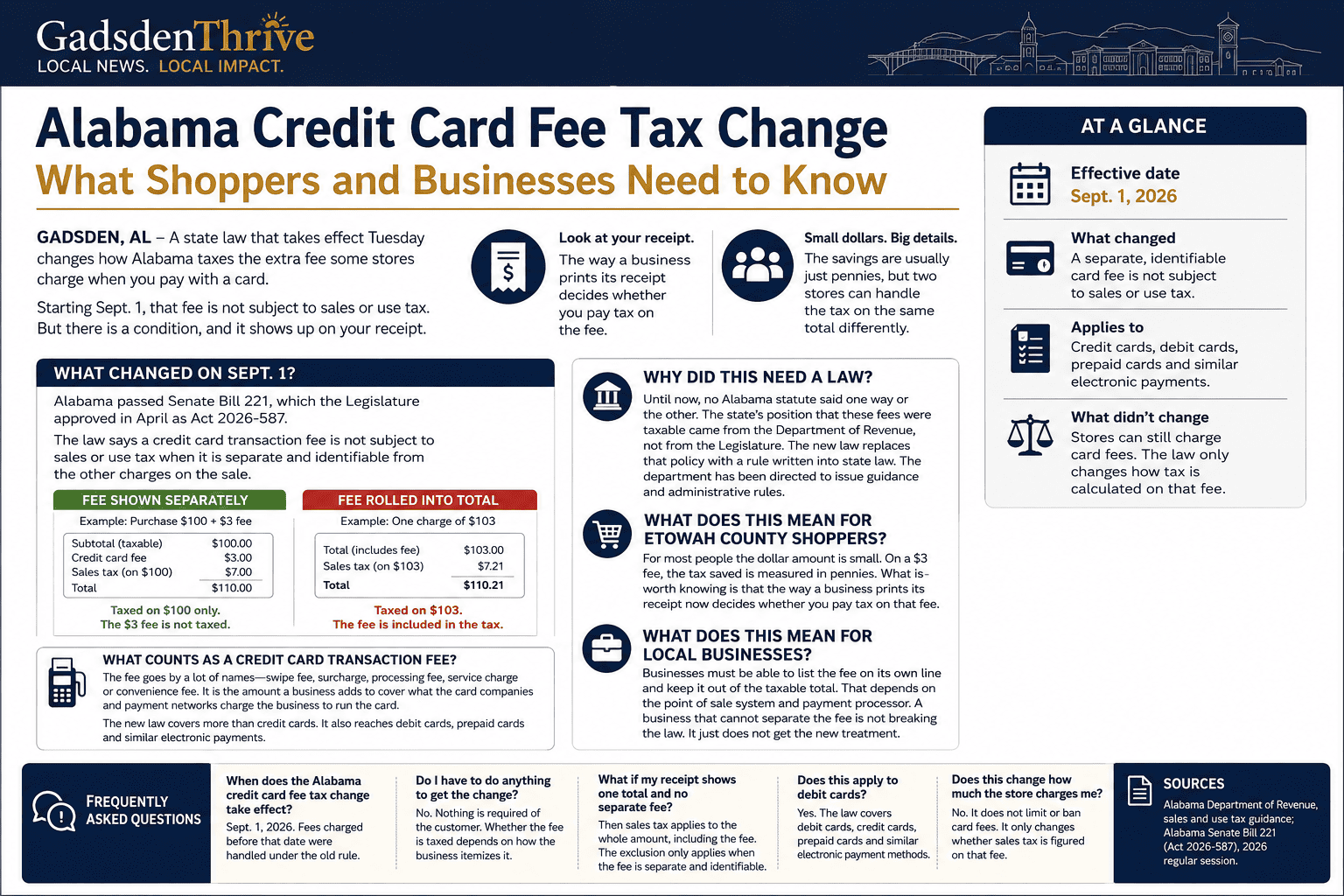
Alabama passed Senate Bill 221, which the Legislature approved in April as Act 2026-587. The law says a credit card transaction fee is not subject to sales or use tax when it is separate and identifiable from the other charges on the sale.
The Alabama Department of Revenue explains it with a simple example. Say you buy something for $100 and the store adds a $3 card fee. If the receipt shows those as two separate charges, tax is figured on the $100 only. The $3 is not taxed.
But if the receipt shows one charge of $103 and does not break out the fee, then sales tax applies to the full $103.
So the same purchase can be taxed two different ways. The difference is how the store writes it up.
What counts as a credit card transaction fee?
The fee goes by a lot of names. Stores call it a swipe fee, a surcharge, a processing fee, a service charge or a convenience fee. It is the amount a business adds to cover what the card companies and payment networks charge the business to run the card.
The new law covers more than credit cards. It also reaches debit cards, prepaid cards and similar electronic payments.
Why did this need a law?
Because until now, no Alabama statute said one way or the other.
The state’s position that these fees were taxable came from the Department of Revenue, not from the Legislature. The department’s guidance held that the fee was part of the retailer’s cost of doing business, and that the whole amount a customer paid for taxable goods was subject to tax. That was true even when the store listed the fee separately.
The new law replaces that policy with a rule written into state law. The department has been directed to issue guidance and administrative rules explaining how it will work day to day.
What does this mean for Etowah County shoppers?
For most people the dollar amount is small. On a $3 fee, the tax saved is measured in pennies.
What is worth knowing is that the way a business prints its receipt now decides whether you pay tax on that fee. Two stores can charge the same total and handle the tax differently.
If you use a card at a business that adds a fee, the receipt is where you can see which approach that business is taking.
What does this mean for local businesses?
More work than it might sound like.
A business that adds a card fee has to be able to list that fee on its own line and keep it out of the taxable total. That depends on the point of sale system and the payment processor. Many systems are set up to calculate tax on the full amount a customer is charged.
A business that cannot separate the fee is not breaking the law. It just does not get the new treatment. The full amount stays taxable.
Businesses that add card fees may want to check with their processor before assuming anything changed automatically on Tuesday.
It is also not the only tax change landing on Etowah County merchants today. Collection of the county’s tobacco taxes moves to the state on Sept. 1, with sellers filing through My Alabama Taxes and the first return due Oct. 20.
Was the fee always taxable before?
Not in every case. Under the old guidance, if the underlying sale was not taxable, the fee was not taxable either.
The department used a haircut as its example. A haircut is not subject to sales tax in Alabama. So if a shop charged $50 for the cut and added a $3 card fee, neither amount was taxed. That part is unchanged.
The change matters for sales of goods that are taxable in the first place.
For more on how local taxes stack up here, see our reporting on what you actually pay in cigarette tax depending on which Etowah County town you buy in.
Frequently asked questions
When does the Alabama credit card fee tax change take effect?
Sept. 1, 2026. Fees charged before that date were handled under the old rule.
Do I have to do anything to get the change?
No. Nothing is required of the customer. Whether the fee is taxed depends on how the business itemizes it.
What if my receipt shows one total and no separate fee?
Then sales tax applies to the whole amount, including the fee. The exclusion only applies when the fee is separate and identifiable.
Does this apply to debit cards?
Yes. The law covers debit cards, credit cards, prepaid cards and similar electronic payment methods.
Does this change how much the store charges me?
No. It does not limit or ban card fees. It only changes whether sales tax is figured on that fee.
Sources
Alabama Department of Revenue, sales and use tax guidance; Alabama Senate Bill 221 (Act 2026-587), 2026 regular session.
Discover more from GadsdenThrive
Subscribe to get the latest posts sent to your email.